
Cotton Crop – Further Management: Pest, Disease, Growth and Fertilizer Management15 September 2026
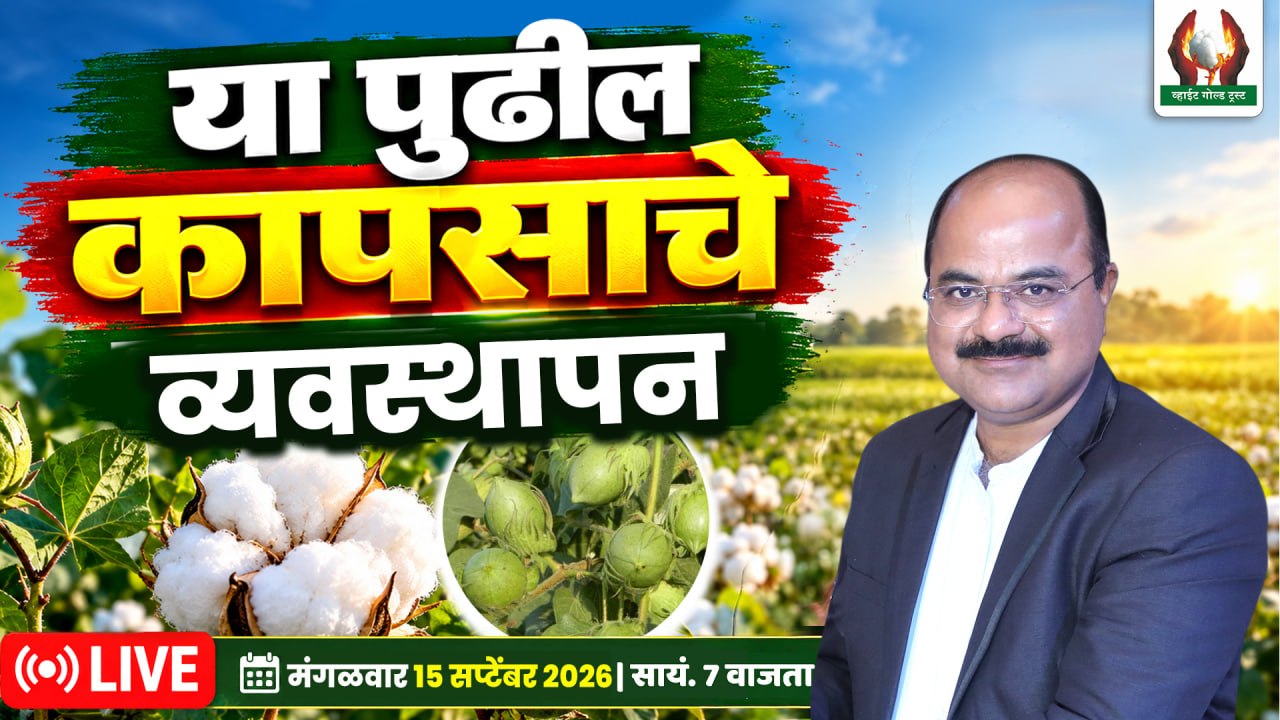
Cotton Crop – Further Management: Pest, Disease, Growth and Fertilizer Management
Guidance by: Mr. Gajanan Jadhav
Date: 15 September 2026
Timely and proper crop management is essential according to the present crop conditions. This guidance focuses mainly on the current management of soybean, cotton and pigeon pea, including pest and disease management, crop growth, fertilizer management, water stress and other important field practices.
Soybean Spray Management
If sufficient moisture is available, the final spray in soybean can be taken.
For the final spray
-
Vitara Plus – 50 ml
-
Sinjo – 10 ml
If required
-
Panda Super – 40 ml
-
Acetamiprid – 15 g
-
Odhachi Extra – 40 ml
In case of disease incidence
Use as required:
-
Nazo Super – 20 ml
-
V-Sulph – 50 g
-
Sukhai – 40 ml
The above dosage is for 20 litres of water.
Present Condition of Cotton and Further Management
The current cotton crop requires attention towards crop growth, pest management, pink bollworm management, excessive vegetative growth, intercultural operations and water stress management.
Management of Cotton with Low Growth
For cotton showing poor or low growth, drenching should be carried out.
Drenching
-
Riser – 1.5 litre
-
NPK – 500 g
-
19:19:19 – 5 kg
Foliar Spray
-
Refresh – 50 ml
-
19:19:19 – 125 g
If pest infestation is observed, an appropriate insecticide spray should be taken as required.
Thrips Outbreak in Cotton
If there is an outbreak of thrips in cotton, timely management is important.
First option
-
Surrender – 50 ml
-
Odhachi Extra – 40 ml
-
Sulpha Boost – 30 g
-
Top Up – 40 ml
Second option
-
Novect or Topuz – 40 g
-
Sulpha Boost – 30 g
-
Top Up – 40 ml
Third option
-
Lambda Cyhalothrin – 30 ml
-
Profenofos – 30 ml
-
Sulphaboost – 30 g
-
Top Up – 40 ml
Management of Shoot and Fruit Borer Infestation
In case of shoot borer infestation in cotton, the following spray combination is provided:
-
Surrender – 40 ml
-
Iman – 15 g
-
Musket – 40 ml
-
Top Up – 50 ml
Three-Pronged Strategy for Pink Bollworm Management
1. Continuous Use of Light Traps
Light traps should be used continuously from the appearance of squares. Moths of the bollworm are attracted towards the light, which helps in reducing the pest population.
2. Regular Monitoring of Flowers
Flowers should be inspected regularly and affected flower buds should be continuously removed and destroyed. This helps in reducing the next generation of infestation.
3. Timely Spray
Within four days after Amavasya (new moon), use Surrender as an ovicidal treatment. At other times, Surrender may be used along with a suitable larvicidal spray.
Management of Excessive Vertical Growth in Cotton
If cotton shows excessive vertical growth:
-
Remove the growing tips of excessively tall plants.
-
Spray suitable growth-retarding growth promoters.
Options
Chamatkar – 2 to 2.5 ml per litre
(300 to 400 ml per acre)
OR
Lihosin – 40 ml per acre
Water Stress in Cotton
When cotton experiences water stress, appropriate nutrient management becomes important.
Fertilizer options
DAP – 1 bag
+
Potash – 1 bag
OR
20:20:00:13 – 1 bag
-
Potash – 1 bag
OR
24:24:00:08 – 1 bag
-
Potash – 1 bag
Fertilizer Management in Cotton under Present Conditions
The following fertilizer options are given:
-
10:26:26 – 1 bag
-
09:24:24 – 1 bag
-
08:21:21 – 1 bag
-
Along with Sulphaboost – 1 kg
If the above fertilizer has already been applied, 50 kg urea per acre should be given at the final stage.
Present Condition of ‘Chhava’ Cotton
The presentation includes a separate section on the present condition of ‘Chhava’ cotton.
Present Condition of Pigeon Pea
In pigeon pea, the presentation indicates an increasing incidence of branch blight / Phytophthora blight.
Management
-
Cryptox / Ridomil – 40 g
For wilting / root rot management
-
Trichoboost DX – 500 g
-
Trichoderma – 2 to 3 kg
Topping in Pigeon Pea
If topping has not yet been carried out, the growing tips can be removed up to 70–80 days.
This practice is intended to help in increasing yield.
Identification and Management of Sterility Mosaic Disease in Pigeon Pea
In sterility mosaic disease:
-
Leaves become shorter.
-
Leaves come close together and appear clustered.
-
The leaves remain green.
-
However, affected plants do not produce flowers or pods.
-
Severely affected plants should be removed.
The presentation identifies it as a viral disease and states that it is spread by mites. To reduce spread, a miticide spray should be taken during September.
For management
-
Omite – 40 ml
-
Abamectin – 20 ml
-
Magister – 40 ml
Use a suitable spray as required.
Topping of Pigeon Pea
Pigeon pea plants that have grown taller than soybean can also be topped by removing the growing tips.
Fertilizer Management in Pigeon Pea
Where fertilizer is required, the following options are mentioned:
-
20:20:00:13 – 1 bag
-
24:24:00:08 – 1 bag
If fertilizer has not yet been applied to pigeon pea, it can be given up to 100 days as stated in the presentation.
Important Message for Farmers
The present stage of the crop requires regular field observation, timely pest and disease management, proper fertilizer application, moisture management and timely corrective measures.
These recommendations are based on the guidance presented on 15 September 2026. Farmers should consider the actual condition of their crop and field while carrying out any management practice.
Watch the Complete Guidance on YouTube
For the complete guidance on “Further Management of Cotton”, watch the YouTube Live video here:
???? YouTube Live:
https://www.youtube.com/live/uS-JUgYb6vo?si=kC9ysWXTfB3TX9t8
White Gold Trust
A Charitable Organization
Chhatrapati Sambhajinagar
Farmer Assistance Helpline: 88 88 16 78 88